

Introduction
The Liability Adequacy Test (LAT) is a key process in the insurance and finance industries that ensures an organization’s liabilities are sufficient to cover future obligations. In simple terms, it helps companies check if the money set aside to pay future claims or benefits is enough.
The liability adequacy test is essential for maintaining transparency, financial stability, and compliance with accounting standards like IFRS 17 and IFRS 4. It helps insurers and financial institutions ensure that their reserves are neither overstated nor understated.
What Is a Liability Adequacy Test?
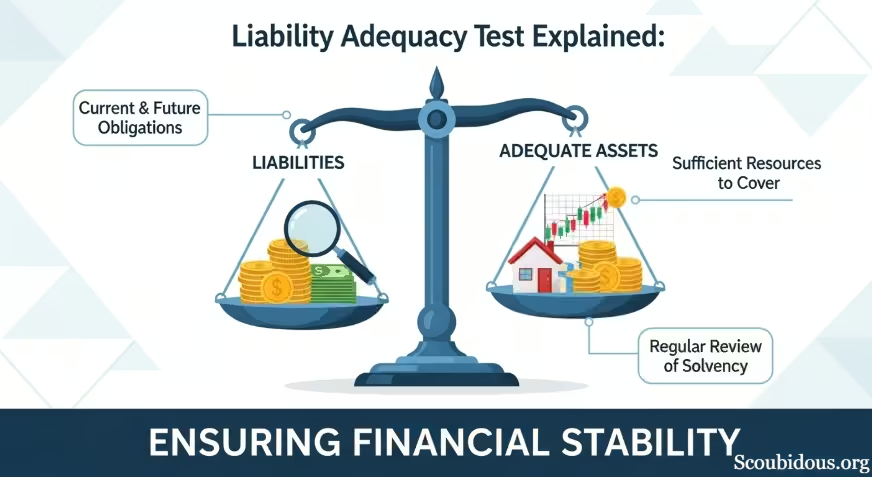
A liability adequacy test is an accounting requirement used to evaluate whether the recognized insurance liabilities are adequate compared to the current estimates of future cash flows. If the existing liabilities are found to be insufficient, the company must recognize an additional expense or loss in its financial statements.
In simple words, it ensures that the company can meet its obligations to policyholders and other stakeholders in the future without facing financial distress.
The Purpose of Liability Adequacy Test
The main purpose of conducting a liability adequacy test is to maintain financial soundness and protect policyholders’ interests. Below are the key objectives:
- Ensure Financial Sufficiency – To verify that insurance reserves are adequate to cover all expected claims and expenses.
- Comply with Accounting Standards – LAT is required under international accounting frameworks like IFRS 17.
- Avoid Understatement of Liabilities – Helps prevent financial losses due to underestimating future obligations.
- Enhance Transparency – Builds trust among investors, regulators, and policyholders by showing accurate financial reporting.
Importance of Liability Adequacy Test in Insurance
In the insurance industry, the liability adequacy test plays a vital role in assessing the strength and reliability of an insurer’s balance sheet.
Insurance companies hold large amounts of policyholder liabilities, such as claims and benefits to be paid in the future. Conducting a liability adequacy test ensures these obligations are properly accounted for.
It also provides early warnings about potential financial shortfalls, allowing management to take corrective actions in time. This ensures long-term stability and trust in the insurance system.
How Liability Adequacy Test Works
The process of conducting a liability adequacy test generally involves comparing the carrying amount of insurance liabilities with the estimated present value of future cash flows expected from those contracts.
If the expected cash flows exceed the liabilities recorded, an additional reserve or loss is recognized in the financial statements.
Steps Involved in LAT:
- Identify Insurance Liabilities – Determine which contracts and liabilities are subject to the test.
- Estimate Future Cash Flows – Include all expected claims, benefits, and related expenses.
- Discount Future Cash Flows – Adjust future cash flows to their present value using appropriate discount rates.
- Compare Liabilities and Cash Flows – Check if existing liabilities are sufficient to meet expected outflows.
- Record Adjustments – If liabilities are inadequate, record a loss or increase the reserve balance.
Key Components of Liability Adequacy Test
When performing a liability adequacy test, several components must be analyzed carefully to ensure accurate results. These include:
- Insurance Liabilities: The obligations that the insurer must pay in the future.
- Unearned Premium Reserve (UPR): The portion of premiums not yet earned but collected.
- Claims Reserves: Money set aside to pay reported and unreported claims.
- Future Cash Flow Projections: Expected payments to policyholders and expenses.
- Discount Rate: Used to convert future payments into present value.
Accounting Standards and Liability Adequacy Test
Under IFRS 4
Under IFRS 4, insurers are required to perform a liability adequacy test to ensure that the recognized insurance liabilities are not less than the present value of estimated future cash flows. If a deficiency is identified, it must be immediately recognized in profit or loss be immediately recognized in profit or loss.
Under IFRS 17
With the implementation of IFRS 17, the liability adequacy test is replaced with a more detailed measurement model. However, the core concept remains the same – ensuring that liabilities are not understated and accurately reflect future obligations.
Difference Between Liability Adequacy Test and Solvency Test
While both tests assess financial stability, they focus on different aspects:
| Aspect | Liability Adequacy Test | Solvency Test |
| Purpose | Ensures liabilities are sufficient for future obligations | Ensures overall financial stability of the company |
| Focus | Accounting and reporting accuracy | Regulatory capital adequacy |
| Scope | Insurance liabilities and reserves | Total assets, liabilities, and capital |
| Standard | IFRS 4 / IFRS 17 | Solvency II / local regulations |
Why Liability Adequacy Test Matters for Stakeholders
The liability adequacy test has implications for various stakeholders, including:
- Policyholders: It guarantees that the insurer has enough funds to pay future claims.
- Investors: It provides confidence in the company’s financial health.
- Regulators: It ensures that insurers comply with global accounting standards.
- Management: It helps identify potential financial risks early and make strategic decisions accordingly.
Challenges in Conducting Liability Adequacy Test
Despite its importance, the liability adequacy test presents several challenges for insurers and accountants:
- Accurate Estimation of Cash Flows: Predicting future claims and expenses can be complex.
- Selection of Discount Rate: Choosing an appropriate discount rate impacts the test results significantly.
- Data Quality: Poor-quality or incomplete data can distort the outcome.
- Regulatory Changes: Frequent updates to accounting standards require continuous adaptation.
- Economic Volatility: Changes in market interest rates or inflation can affect assumptions.
Best Practices for Performing Liability Adequacy Test
To ensure the accuracy and reliability of the liability adequacy test, companies can follow these best practices:
- Use reliable actuarial models for cash flow projections.
- Regularly update assumptions to reflect current economic conditions.
- Maintain clear documentation for regulatory compliance.
- Engage qualified professionals to perform and review the test.
- Integrate risk management frameworks to detect early warning signs.
The Future of Liability Adequacy Test
As the financial world evolves, the liability adequacy test continues to play a key role in financial reporting and risk management. With the adoption of IFRS 17, insurers will have access to more advanced models and tools for measuring liabilities more accurately.
Technological advancements, such as automation and data analytics, are also improving the efficiency and precision of these tests. In the future, liability adequacy tests will likely become even more integrated with enterprise risk management systems.
Conclusion
The liability adequacy test is an essential process that ensures financial integrity, regulatory compliance, and stakeholder confidence. By evaluating whether insurance liabilities are sufficient to meet future obligations, it provides a clear picture of an organization’s financial strength.
In an era where accuracy and transparency are critical, understanding and properly implementing the liability adequacy test helps safeguard both companies and their customers.