
Introduction
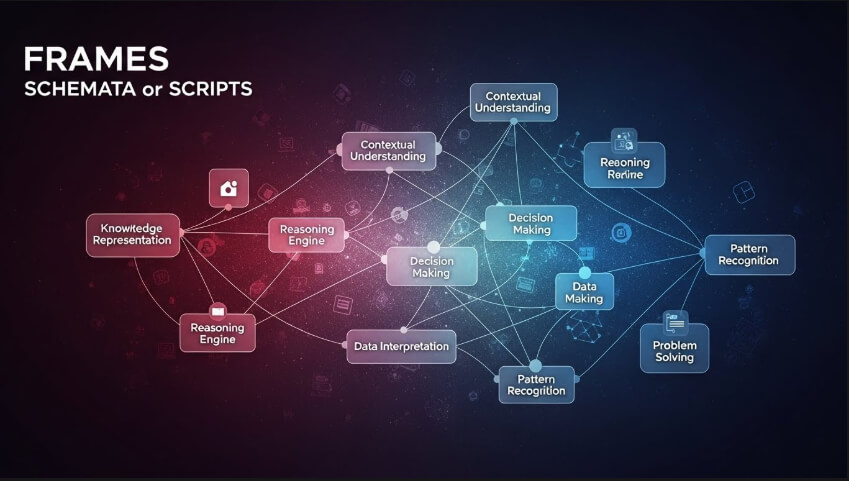
Frames in artificial intelligence play an important role in how machines understand and organize knowledge. As artificial intelligence systems become more advanced, the need for structured knowledge representation grows.
Frames in artificial intelligence help computers store information in a way that is logical, meaningful, and easy to use.
This concept was introduced to allow AI systems to represent real-world situations, objects, and experiences in a structured format.
Frames in artificial intelligence make it possible for machines to reason, learn, and make decisions more effectively.
What Are Frames in Artificial Intelligence?

Frames in artificial intelligence are data structures used to represent knowledge about objects, events, or situations. Each frame contains information in the form of attributes and values.
These attributes describe characteristics, relationships, or behaviors related to the object or concept.
A frame can be thought of as a digital version of how humans store knowledge. When people think about an object, they recall its properties and related information.
Frames in artificial intelligence work in a similar way, allowing machines to understand context and meaning.
History and Origin of Frames in Artificial Intelligence
The idea of frames in artificial intelligence was introduced during early AI research to improve knowledge representation. Researchers wanted AI systems to move beyond simple rules and logic.
Frames were developed to represent common situations and experiences. This approach allowed AI systems to store complex information in a more natural and organized way, similar to human memory.
Why Frames in Artificial Intelligence Are Important
Frames in artificial intelligence help bridge the gap between raw data and meaningful knowledge. Without structured representation, AI systems struggle to interpret information correctly.
By using frames in artificial intelligence, systems can understand relationships between concepts. This leads to better reasoning, faster decision-making, and improved learning capabilities.
Structure of Frames in Artificial Intelligence
Slots and Values in Frames
Frames in artificial intelligence consist of slots and values. Slots represent attributes, while values store information related to those attributes.
For example, a frame representing a vehicle might include slots such as type, color, speed, and fuel. Each slot holds a specific value that describes the object.
Default Values in Frames
Frames in artificial intelligence often include default values. These are assumptions made when specific information is not available.
Default values help AI systems make reasonable decisions even when data is incomplete.
Inheritance in Frames
Inheritance is a key feature of frames in artificial intelligence. Frames can inherit properties from other frames.
For example, a car frame can inherit properties from a vehicle frame. This reduces repetition and improves efficiency in knowledge representation.
Types of Frames in Artificial Intelligence
Class Frames
Class frames represent general categories or classes of objects. They define common properties shared by all members of the class.
Frames in artificial intelligence use class frames to organize knowledge hierarchically.
Instance Frames
Instance frames represent specific examples of a class. They contain unique information related to a particular object.
Frames in artificial intelligence use instance frames to store detailed and specific knowledge.
Event Frames
Event frames represent actions or occurrences. They describe what happens, when it happens, and who is involved.
Frames in artificial intelligence use event frames to understand processes and sequences.
How Frames in Artificial Intelligence Work in Real Life
Frames in artificial intelligence are widely used in real-world applications. They help AI systems interpret complex information efficiently.
By structuring data logically, frames allow machines to recognize patterns, make predictions, and respond intelligently.
Frames in Artificial Intelligence and Expert Systems
Expert systems rely heavily on frames in artificial intelligence. These systems mimic human expertise by storing knowledge in structured formats.
Frames help expert systems represent rules, facts, and relationships in a way that supports logical reasoning and problem-solving.
Role of Frames in Artificial Intelligence in Natural Language Processing
Natural language processing requires understanding meaning and context. Frames in artificial intelligence help interpret language by representing concepts and relationships.
When an AI system processes text, frames allow it to understand words within a broader context, improving accuracy and relevance.
Frames in Artificial Intelligence and Machine Learning
Although machine learning focuses on data-driven models, frames in artificial intelligence still play a supporting role.
Frames help organize training data and represent background knowledge. This combination improves learning efficiency and interpretability.
Advantages of Using Frames in Artificial Intelligence
Clear Knowledge Representation
Frames in artificial intelligence provide a clear and organized way to represent knowledge. This structure improves understanding and usability.
Improved Reasoning Ability
AI systems using frames can reason more effectively. They can draw conclusions based on stored relationships and attributes.
Reusability of Knowledge
Frames support inheritance, allowing knowledge to be reused across different concepts. This saves time and resources.
Flexibility and Scalability
Frames in artificial intelligence can be easily updated or expanded. New information can be added without redesigning the entire system.
Limitations of Frames in Artificial Intelligence
Despite their benefits, frames in artificial intelligence have limitations. They may struggle with highly dynamic or uncertain environments.
Frames rely on predefined structures, which can limit adaptability in some cases. Human intervention may still be needed for complex decision-making.
Comparison of Frames in Artificial Intelligence with Other Knowledge Representation Methods
Frames differ from rule-based systems and semantic networks. While rules focus on logic and conditions, frames emphasize structure and context.
Frames in artificial intelligence provide a balance between flexibility and organization, making them suitable for many applications.
Conclusion:
Frames in artificial intelligence remain a foundational concept in AI research and development. They provide a structured way to represent knowledge, enabling machines to understand and reason effectively.
By combining frames with modern AI technologies, developers can build smarter, more reliable systems. Frames in artificial intelligence continue to shape the future of intelligent systems.