
Introduction
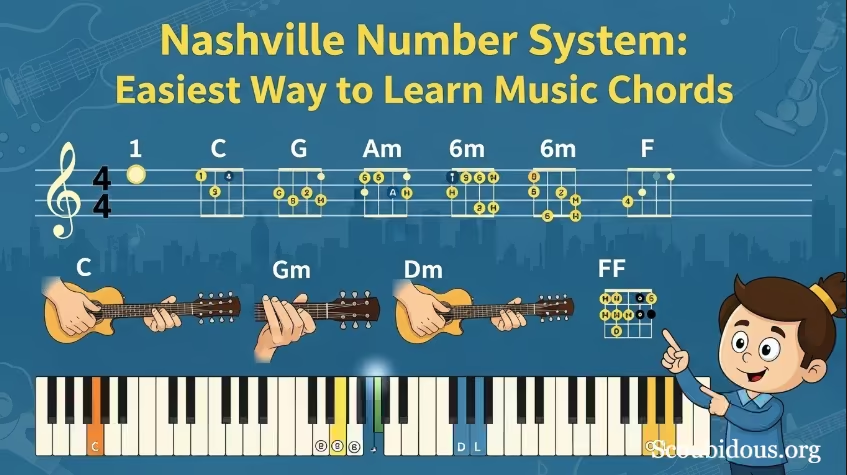
The world of music comes with many methods to write and understand chords. One of the most popular and widely used systems today is the Nashville Number System.
Whether you are a beginner, a professional musician, or simply someone curious about how songs are arranged, this system makes music easier to learn and play.
In this article, we will explore what the Nashville Number System is, how it works, and why it has become an essential tool for musicians around the world.
What Is the Nashville Number System?
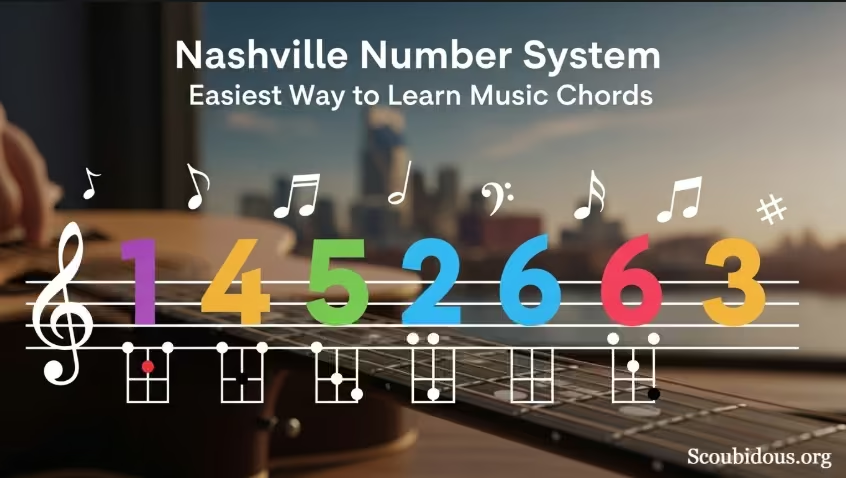
The Nashville Number System is a simple way of writing chords using numbers instead of traditional chord names. Instead of writing C major, G major, or A minor, the system uses numbers like 1, 4, and 6. Each number represents a degree of the musical scale.
This system was created in Nashville, Tennessee, a city known for producing some of the world’s best musicians and songwriters. It was designed to make things easier during quick recording sessions where musicians needed to follow chord progressions immediately.
Why the Nashville Number System Was Created
The Nashville Number System was developed to solve a major problem in music: how to quickly communicate chord changes without rewriting the entire song in a different key.
Musicians in Nashville often had to change song keys for different singers. Instead of rewriting every chord, they used numbers to represent the chord positions in the scale. This saved time and made collaboration easier.
Today, the system is used worldwide in studios, live performances, and music education.
How the Nashville Number System Works
To understand the Nashville Number System, you need to know one basic idea: every musical key has seven notes. Each note becomes a number in the system.
For example, in the key of C major:
- 1 = C
- 2 = D
- 3 = E
- 4 = F
- 5 = G
- 6 = A
- 7 = B
Instead of writing “C – F – G,” the system writes “1 – 4 – 5.”
This also works in any other key. In the key of G major:
- 1 = G
- 4 = C
- 5 = D
The same 1 – 4 – 5 progression works in every key.
Understanding Major and Minor Chords in the Nashville Number System
The Nashville Number System uses symbols to show whether a chord is major, minor, or dominant.
- Major chords use plain numbers (1, 4, 5)
- Minor chords add a minus sign or lowercase “m” (2-, 3-, 6-)
- Dominant chords use a “7” (5⁷)
For example, in the key of C major:
- 1 = C major
- 2- = D minor
- 3- = E minor
- 4 = F major
- 5 = G major or G7
- 6- = A minor
The system stays simple but still gives all the information a musician needs.
How the Nashville Number System Helps Beginners
Many music learners struggle with memorizing long chord charts. The Nashville Number System lets beginners focus on chord movement instead of complicated names.
It teaches patterns, not individual chords
Most songs use common patterns like:
- 1 – 4 – 5
- 1 – 6 – 4 – 5
- 2 – 5 – 1
These patterns are easier to remember and apply to any key.
It improves creativity
Beginners can change the key of a song without confusion. This helps with singing, practicing, and songwriting.
The Nashville Number System in Different Music Genres
Even though it began in country music, the Nashville Number System is now used in:
- Pop
- Rock
- Gospel
- Jazz
- Worship music
- R&B
- Folk
It has become a universal language for musicians everywhere.
Why the Nashville Number System Is Easy to Learn
The biggest reason musicians love this system is its simplicity. Anyone who knows the scale numbers can understand chord progressions with little effort.
No need to memorize many chord names
A single chart works for every song key.
You can use it with any instrument
Whether you play guitar, piano, violin, or bass, the system works the same.
It teaches musical structure
You start understanding how songs are built, which improves performance and songwriting.
Examples of Nashville Number System Progressions
Here are some common progressions using the Nashville Number System:
1. The Classic 1 – 4 – 5 Progression
Used in thousands of songs across all genres.
2. The Popular 1 – 6 – 4 – 5 Progression
Very common in pop and modern music.
3. The 2 – 5 – 1 Progression
Used heavily in jazz and gospel music.
4. The 1 – 5 – 6 – 4 Progression
Used in emotional ballads and slow songs.
These patterns help musicians learn songs quickly.
Nashville Number System Symbols You Should Know
The Nashville Number System uses a few simple symbols:
- Dot above number → higher octave
- Dash under number → lower octave
- Slash ( / ) → bass note (example: 1/3)
- Diamond shape → hold the chord
- Push sign (>) → play slightly before the beat
These symbols help musicians play a song exactly as the songwriter intended.
Steps to Learn the Nashville Number System
To start using the Nashville Number System, follow these simple steps:
1. Learn the major scale
Know the 1 to 7 positions in different keys.
2. Learn basic chords
Understand major and minor chords.
3. Practice simple progressions
Use easy number patterns like 1 – 4 – 5.
4. Try transposing
Switch to another key using the same numbers.
5. Create your own number charts
Start using the system for every song you learn.
Why the Nashville Number System Remains Popular Today
The Nashville Number System continues to be the preferred method of chord notation because it balances simplicity and power.
It works for beginners, advanced players, songwriters, and producers. It saves time, increases creativity, and makes musical communication faster.
In a world where music constantly evolves, the Nashville Number System remains a timeless tool.
Conclusion:
The Nashville Number System is more than just a method—it is a complete language for musicians. It helps with quick learning, effective communication, smooth transposition, and better understanding of musical patterns.
Whether you are just starting or already a professional, this system can make your musical journey easier and more enjoyable.
If you want a simple way to understand and play music, learning the Nashville Number System is one of the best steps you can take.